After egg retrieval, your eggs and embryos spend the next six days in our IVF laboratory, and the milestone updates from our team use terms like pronuclei, morula, expansion grade, and PGT-A.
Each term marks a specific point in early development and tells our embryologists how an embryo is progressing toward the blastocyst stage, where most transfer, freezing, and testing decisions are made during in vitro fertilization (IVF).
| Day | Approximate Timing | What Embryologists Expect to See |
|---|---|---|
| Day 1 | About 17 hours | Two pronuclei confirm fertilization |
| Day 2 | About 44 hours | Around 4 cells |
| Day 3 | About 68 hours | Around 8 cells |
| Day 4 | About 92 hours | Compacting cells forming a morula |
| Days 5 to 6 | About 116 hours and beyond | Blastocyst with two distinct cell types |
About 17 Hours After Insemination

IVF begins with the retrieval of mature eggs (oocytes) from the ovaries. In our lab, eggs are most often fertilized with intracytoplasmic sperm injection (ICSI), a technique in which an embryologist selects a single sperm and injects it directly into the egg.
Roughly 17 hours later, the embryologist checks each egg under the microscope. A normally fertilized egg, now called a zygote, shows two pronuclei sitting side by side near its center. These two small round structures develop from the egg and the sperm.
An egg with only one pronucleus, or with three or more, generally has low potential for a viable pregnancy, so those zygotes are not selected for transfer. The day 1 check tells us how many eggs fertilized normally, and it is usually the first number patients hear.
From 2 Cells to About 8

Over the next two days, the zygote divides again and again in a phase called cleavage. An embryo that is developing on schedule usually reaches about four cells by day 2 and about eight cells by day 3.
Embryos that follow that four-then-eight pattern have historically shown the strongest results among day 3 embryos. Our embryologists look at both the cell count and how evenly the cells are dividing, since uniform division is an early sign of healthy development.
Until roughly the four to eight cell stage, the embryo relies on instructions and materials stored in the oocyte. Between those stages, the embryo's own genes switch on and begin to direct its development.
About 92 Hours After Insemination

By day 4, the embryo has usually become a morula, a solid ball of cells. Most embryos begin to compact at this point, with their cells pressing closely together. An embryo with more than ten cells that still has not compacted on day 4 is considered unusual.
It is normal for some embryos to stop developing between day 3 and day 5. Weaker embryos often do not survive extended culture, which is part of why growing embryos to the blastocyst stage helps our team identify the ones with the strongest potential.
Two Cell Types and a Fluid-Filled Cavity

Between day 5 and day 6, embryos that keep progressing form a blastocyst. A fluid-filled cavity opens inside the embryo, and for the first time, its cells separate into two distinct cell lineages.
The trophectoderm is the outer layer of cells, which goes on to form the placenta and supporting tissues. The inner cell mass is a cluster of cells on the inside that develops into the baby. Selecting embryos at this stage helps improve implantation success rates.
Blastocysts can be biopsied for genetic testing on day 5, 6, or 7, so an embryo that reaches the blastocyst stage a day later is not automatically ruled out.
As the blastocyst expands, the zona pellucida, the protective outer shell around the embryo, thins. The trophectoderm then begins to push through it in a process called hatching. Hatching has to happen before an embryo can implant in the uterine lining (endometrium).
Decoding a Grade Like 4AB
Blastocysts are commonly described with a three-part grade. The number, from 1 to 6, tracks how far the blastocyst has expanded and hatched. The first letter rates the inner cell mass, and the second rates the trophectoderm, with A as the highest.
4: an expanded blastocyst whose cavity is larger than the original embryo, with a thinned outer shell.
A: an inner cell mass made of many tightly grouped cells.
B: a trophectoderm forming a looser layer of cells.
A grade describes how an embryo looks at a single moment. Lower-graded embryos have led to healthy pregnancies many times, and our embryologists weigh grade alongside cell number, appearance, and developmental stage. In late 2025, we also announced plans to bring artificial intelligence into our embryology lab to support more consistent grading, with our embryologists continuing to lead every decision.
PGT-A, Formerly Called PGS
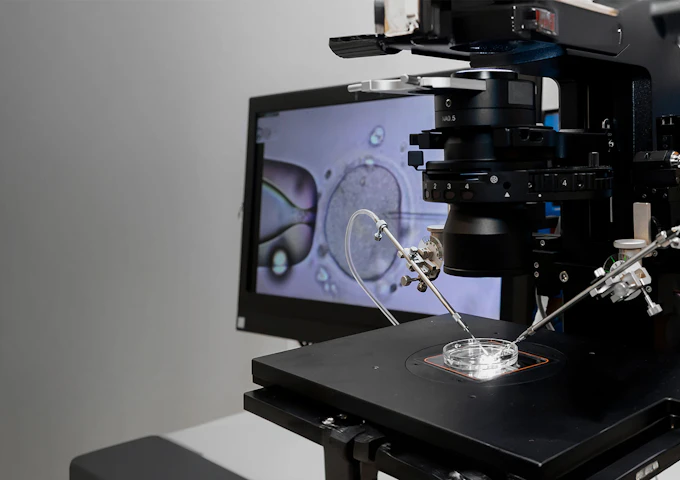
The blastocyst stage is when an embryo can be biopsied for preimplantation genetic testing for aneuploidy, or PGT-A. You may also see it called preimplantation genetic screening (PGS), its earlier name.
An embryologist removes a small sample of trophectoderm cells, the cells that will become the placenta, and leaves the inner cell mass untouched. The sample is then checked for an abnormal number of chromosomes.
After the biopsy, embryos are frozen through vitrification while the analysis is completed, which typically takes about a week. Results may show an embryo as euploid (normal), aneuploid (abnormal), or mosaic, and our practice will consider transferring mosaic embryos, especially for patients who have no euploid embryos.

Current evidence has not shown that PGT-A benefits every IVF patient as a routine test, so it remains optional, and our team can help you decide whether it fits your situation.
Accredited by The Joint Commission

Each of these milestones happens inside our accredited laboratory. The LifeAire system purifies the air to protect embryos from environmental threats, and the RI Witness system uses RFID tags to track eggs, sperm, and embryos throughout every stage.
Our lab also holds oversight from the College of American Pathologists, CLIA, and SART, and reports its data through SART and the CDC. Throughout your cycle, our team provides updates at key milestones, so you know where your embryos stand between retrieval and transfer.
Our fertility specialists and embryologists can walk you through every stage of IVF, from retrieval to transfer.
Denver Fertility Care was founded in 2010 to provide exceptional, state-of-the-art fertility treatments tailored to each patient's unique journey. Led by Dr. Dana Ambler, who is board certified in Obstetrics and Gynecology as well as in Reproductive Endocrinology and Infertility, our highly trained team is dedicated to helping you achieve the family of your dreams with compassionate, comprehensive care. Our affiliations include:
To learn more, schedule a consultation by filling out our online form, or call: (720) 420-1570.
Locations
We have 2 locations the greater Denver area